


To keep up with these changes, I've been doing some experiments myself. I'm testing different formats and networks both on my Latte Design profile and on my personal profile, where I share about travel. Instagram, LinkedIn, Facebook, YouTube, TikTok, Substack… And one thing is clear: People are much more interested in people than in companies.
This makes the scenario more difficult for those who serve B2B clients, an area in which I and many of my clients work.
When someone is scrolling through their feed, they're unlikely to want to see content about a service they might need once or twice a year. A marketing professional probably doesn't want to see posts about branding in their free time. Just like I don't necessarily want to see content about air conditioning installation, accounting, or security systems in my feed.
We want other things: a tip to make life easier, a cool place to eat, a trip, a joke, an opinion, a story, a cause we identify with. And the algorithms know this. In other words, content that shows people talking to people resonates better because it generates a connection that purely institutional communication can hardly create.
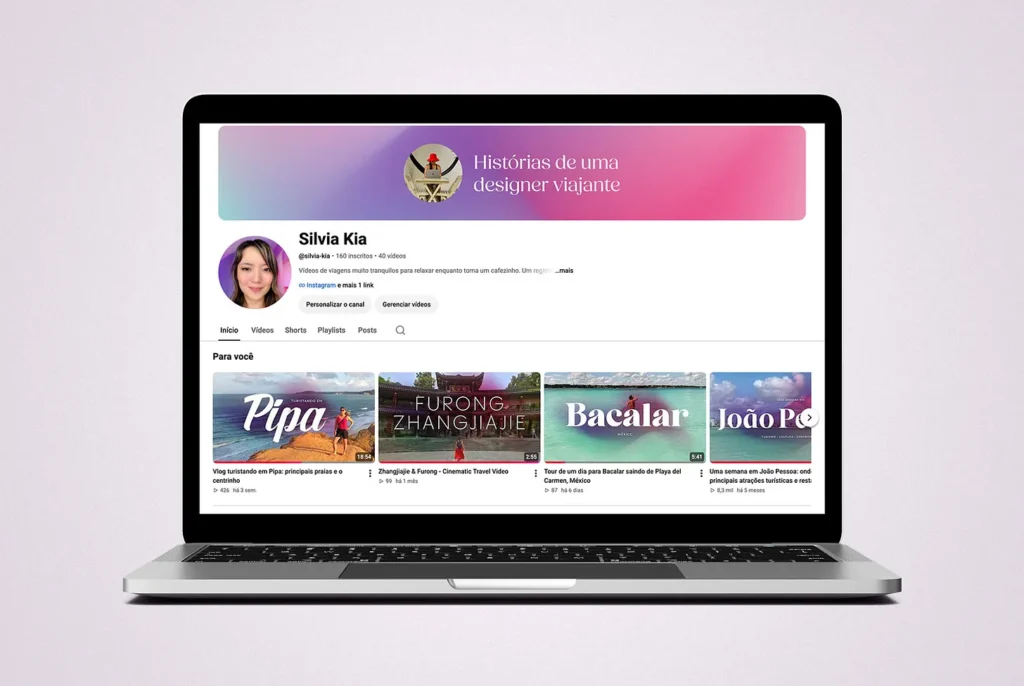
Testing out my new travel channel.
Since last year, I've started sharing more about my travel experiences on my personal profile with photos, short videos, and long vlogs on YouTube. On the Latte Design profile, I mix travel, digital nomadism, some analyses of other markets, and curiosities from a designer's perspective, all in a light and personal tone. In other words, I've changed my profile from “brand specialist” to “a traveling designer.”.
The result?
The travel profile is performing much better, for obvious reasons: it appeals to the desires and passions of many people. But it's also working for the professional profile, although at a slower pace.
The strategy, then, shifted from “teaching branding” while maintaining that serious profile to demonstrate my authority and my 20+ years of professional experience. I preferred to talk to you as Silvia: a designer who works with brands, but who also enjoys traveling, observing other cultures, eating different foods, and understanding how people and businesses operate in different parts of the world.
Because, when we meet someone regardless of their professional context, isn't it also interesting to discover who's behind that corporate presentation? Sometimes, a connection is born from something simple and everyday.
I've already exchanged photos of my dogs with a client, and we spent a good amount of time talking about them. Another client mentioned that they had hiked across the Lençóis Maranhenses, a topic that interested me because it's on my bucket list. Someone else said they'd been to Bhutan—isn't that amazing?
It's these small conversations that make a professional relationship more than just professional. It becomes longer and more memorable. And when she needs your product or service, she'll remember you.
And, technically, what did I learn about each network?
After testing different formats and channels, these are my impressions:
LinkedIn: I think it's the network that makes the most sense for most companies. It's a more serious communication style, sometimes even too serious, and at times it gives me the feeling of a big ego battle. But the companies are there. So, even with engagement that has been decreasing over the years if you don't pay, it's worth maintaining a consistent presence and showing that you and your company are active, as well as interacting with your network of contacts.
Instagram: Personal content or content related to the interests of the end consumer tends to work better, especially among those... millennials. It's a battle for attention in the first few seconds, and the content usually disappears within 24 hours. For B2B, this makes the task more difficult: it requires frequency and, preferably, the figure of a person who sparks curiosity. Purely institutional posts rarely go very far, unless they address a topic of broader interest.
So, what about Reels versus carousels? For now, I'd say post both. Reels tend to bring more reach, while carousels usually generate more engagement, saves, and shares. But there's no formula; you need to test what works for each niche, plus the fact that the algorithm changes frequently.
Facebook: For me, it died a long time ago. Organic reach has dropped significantly, and without investing in paid posts, I feel the reach is extremely low. The platform now has a larger Gen X audience, and the communities still seem to have engagement.
I've heard stories of people who are able to work well with Facebook, but honestly, I don't see it as a very strong player in the digital marketing strategies I follow.
TikTok: Here, the competition for attention is even greater, haha. The format is essentially short videos, focused on a younger audience (Generation Z and younger). When a video goes viral, the reach can be enormous. But it doesn't matter so much who you follow or who posted it. The algorithm is very efficient at delivering content it considers relevant to you, even if it comes from profiles you've never seen. So it's difficult to build a community there and engage with your followers.
YouTube: I started my travel channel, @silvia-kia, I started watching it last year, and despite the hard work it takes, it's the channel I'm enjoying the most. Aside from Shorts, which is a copy of TikTok, YouTube works very well with long videos. The user watches one video at a time, more calmly, and this allows for the development of more complete content.
The impact is also different: it's often slow. New channels grow gradually, but the content continues to work after it's published. I have a 22-minute video that I posted last year and that, little by little, reached over 8,000 views over eight months. Which is quite a lot for a channel with only 160 subscribers. And it continues to grow.
Another advantage is the variety of content and audiences. It can be vlogs, tutorials, commentary, humor, or less obvious things like ASMR or music to help dogs sleep. It's possible to reach very different audiences, from the youngest to the oldest. Plus, you get a very detailed access report (Analytics).
It might not be the right channel for every company, but in terms of audience diversity and content longevity, I consider YouTube one of the most comprehensive platforms.
Substack: This platform goes a bit against the grain compared to others. It's a mix of a blog and the old Twitter. It's focused on writing, so it has many writers sharing long and reflective texts. It also has a newsletter distribution system and a notes section where you can chat with other users.
So, what to do?
For small businesses, I wouldn't put all my eggs in one basket. Having a presence on more than one channel helps diversify your audience and, most importantly, avoids dependence on a single platform. After all, social networks are born, grow, change, and can even die. You don't need to be on all of them, but I would bet on at least three that make sense for your niche.
You know that popular saying, “out of sight, out of mind”? Well, frequency is a very important factor in promoting a company.
And finally, instead of producing cold, technical, and overly commercial texts, let the people behind the brand shine through.
Because people don't want to talk to “a company.” They want to talk to Silvia, Roberto, Mari, Fernando…
Therefore, the current strategy is to further humanize brand communication.